Back in 1912, a man by the name of St. John O'Sullivan wrote a short book entitled, "
Little Chapters About San Juan Capistrano". About four years ago, I transcribed the book word-for-word, and reprinted it on the old OCThen.com website. Today, I reformatted the pages, and linked them up to the present-day blog site. Click the link above to see it.
O'Sullivan was the first resident priest of Mission SJC since its restoration in 1895. He was actually the one who started the restoration.
It was around the 1880's when Californians rediscovered the missions lining the coast. A "renaissance" period started which lasted until around the 1930s. During this time, people fell in love with the California missions, and saw them as beautiful oases in the middle of savage wilderness. They saw the missionaries as gentle souls, who wanted nothing more than to teach the native indians about Art, Science, and Agriculture.
O'Sullivan was very much caught up in the "romanticism" of the period, and his writing very much reflects this perception. Throughout the 20th Century and into today, schools use this same perception when teaching California students about the mission system.
However, it was only until the last 10-20 years that historians have been telling the true story of the mission system, its purpose to support the military bases (Presidios), the torture and slavery of the native indians, the abolishment of their language and culture, and the political in-fighting between Father Serra and the Governor of California.
One of the best books I've read thus far on this subject is "
Life in a California Mission", by Malcolm Margolin. The book is actually a transcription of the journals of Jean Francois de La Perouse. Perouse was an explorer dispatched by France in 1786 to learn about what the Spanish were doing along the California Coast. He landed in Monterey Bay, and met with Father Fermin Lasuen, the man who took over for Father Serra. Serra had died two years before Perouse landed in Monterey. He recorded everything he saw into his journals. To say the least, this book competely changed my perception of the California missions, and of Father Serra.
Anyone wishing to learn more about how Mission San Juan Capistrano was built, and what each of the buildings and structures mean, might do well to start with "
Little Chapters About San Juan Capistrano".
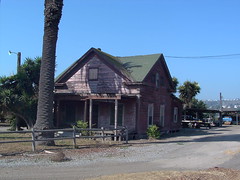 The first wooden structure built in San Juan Capistrano is the Congdon House. Exact date of construction is not known, but I've references to 1876, 1877, and 1878.


 Orange County Memories is about the history of Orange County, CA as told from the people who lived and worked here.